


What is Core Project?
Core Project is a project that We SSI proactively promote in order to conceive and realize future society for our lives.
We target the project whose representative is a researcher in Osaka University and for adopted projects, we provide full support, such as subsidizing research expenses.
Now following 7 core projects are advancing research aimed at solving social issues from the perspectives of "protecting", "nurturing" and "bonding" life.
-
Improving access to information to promote global understanding
-
Cultivating Questions and Language to Live with "Unknowing": Theoretical and Practical Research on Unlearning
-
Building an Industry–Academia–Government Co-creation Network for Advancing Women's Careers and Achieving Gender Equity
-
Osaka University and the local community co-create biodiversity conservation
-
Nuturing children and future with local community: Practice and theory of the co-creation network
-
Science and Humanity for Fostering a Super-aged Society that Respects Individual’s Views on Life and Death and Their Autonomy
-
Realization of an empathetic economy through the promotion of stakeholder-ESG management, ethical consumption and sustainable procurement
- Improving access to information to promote global understanding
- Cultivating Questions and Language to Live with "Unknowing": Theoretical and Practical Research on Unlearning
- Building an Industry–Academia–Government Co-creation Network for Advancing Women's Careers and Achieving Gender Equity
- Osaka University and the local community co-create biodiversity conservation
- Nuturing children and future with local community: Practice and theory of the co-creation network
- Science and Humanity for Fostering a Super-aged Society that Respects Individual’s Views on Life and Death and Their Autonomy
- Realization of an empathetic economy through the promotion of stakeholder-ESG management, ethical consumption and sustainable procurement
(as of Apr 2026)
Core Project
Improving access to information to promote global understanding
Virgil Hawkins |Professor, Graduate School of International Public Policy
Project Overview
In an increasingly globalized world, the flow of information is essential for understanding the complex issues that affect societies. Public understanding of challenges emphasized in the United Nations Sustainable Development Goals (SDGs)—such as armed conflict, poverty, public health, and environmental issues—is critical for identifying effective solutions. However, many people face significant barriers when accessing and comprehending information that influences global sustainability and social dynamics.
This project aims to improve access to information from two key perspectives:
- Enhancing access to information related to conflict resolution
- Expanding access to information on pressing global issues through news media
1) Improving Access to Conflict Resolution Information
The United Nations Security Council (UNSC) is a principal organ of the UN responsible for maintaining international peace and security. Despite its critical role, UNSC resolutions are currently available online only as chronological PDF documents, making it difficult to grasp the Council’s activities and decision-making processes.
This project aims to develop a UNSC resolutions database that enables diplomats, researchers, and the general public to easily access, filter, and search resolutions. Users will be able to explore resolutions based on categories such as economic sanctions, peacekeeping operations, and thematic issues.
Key components of this initiative include:
- Development of an internal interface: Researchers involved in the project will use this interface to input and categorize analyzed resolution data based on content.
- Creation of a public interface: A user-friendly website will allow general users to easily search and filter resolutions based on their content, thereby enhancing understanding of UNSC actions.
By reorganizing and presenting UNSC resolutions in a more accessible format, this database will improve public understanding of international decision-making processes and provide insights into how resolutions influence global conflict resolution, peacekeeping, and humanitarian interventions.
2) Expanding Access to Global Issues through News Media
The second component of this initiative addresses the limitations of current international news coverage. Media outlets report on only a small fraction of global events, often overlooking critical issues that deserve public attention.
The Global News View (GNV) website, established by the project’s principal investigator in 2016, is an existing platform that aims to provide comprehensive reporting and analysis of global events. Currently available in Japanese, the platform analyzes mainstream media coverage while also focusing on underreported issues.
Key components of this initiative include:
- Enhancing GNV functionality: Improving archival features to make nine years of accumulated information more accessible to the public
- Developing and maintaining an English version: Enabling a global audience, including non-Japanese speakers, to access content and encouraging contributions from a more diverse, international group of writers
- Introducing additional tools to improve user access: Implementing various tools to create a more dynamic and information-rich platform, including improvements in data collection and analytical presentation
Through these enhancements, GNV aims not only to raise public awareness but also to foster informed discussions on critical global issues.
Significance and Expected Outcomes
By addressing barriers to information access from the dual perspectives of conflict resolution decision-making and comprehensive international news coverage, this project seeks to cultivate globally informed citizens who are better equipped to engage with and contribute to solving world issues.
Providing individuals with the knowledge necessary to understand and discuss critical global challenges is essential for promoting collective action and generating sustainable solutions to the pressing issues of our time.
Cultivating Questions and Language to Live with "Unknowing":Theoretical and Practical Research on Unlearning
OKABE Mika |Professor, Graduate School of Human Sciences
Project Overview
Modern society has long pursued safer, more stable, and more comfortable lives—aspirations widely shared by citizens. However, today, this very society is revealing serious dysfunctions across multiple domains.
This project identifies the root of these dysfunctions not only in institutional inadequacies but also in the fundamental nature of human experience itself. Human experience inherently contains a pathos dimension that cannot be fully captured by logos-based language—that is, language used for systems of authority, evaluation, and explanation. Moreover, there exists a gap between the lived reality of human life (life as existence, biography, and daily living) and the language available to express it.
Etymologically, experience (ex-periri) implies venturing outside familiar, stable conditions into uncertainty and risk, undergoing trial and error, and being transformed through that process—including not only growth but also loss and distortion. From this perspective, experience has at least two dimensions:
A logos-oriented dimension, where experiences are structured, predictable, measurable, and transferable, and can be evaluated and accumulated as skills or competencies.
A pathos-oriented dimension, where experiences exceed existing frameworks of understanding and cannot be fully articulated, leaving behind a residue of “unknowing” that unsettles established language and thought.
This "Unknowing" is not merely a lack of knowledge but a fundamental mark of having truly lived an experience. It appears not only in extreme situations such as disasters but also in everyday human interactions.
Core Problem
Although such experiences accumulate within individuals, they often remain socially invisible unless articulated through language. However, the language we acquire—especially through formal education—is often dominated by master narratives: standardized, socially sanctioned ways of speaking and understanding.
As a result, individuals tend either to force their experiences into existing frameworks or to abandon attempts to articulate them altogether. This leads to the erasure of the unique, lived meaning of experience.
Contemporary youth, in particular, are often able to “use” dominant narratives but lack the language to express their own experiences differently. In a society that itself produces a sense of difficulty in living, relying solely on such narratives limits both personal authenticity and the possibility of envisioning alternative futures.
Drawing on the work of Gayatri Chakravorty Spivak, this project highlights how dominant discourses can suppress marginalized voices. Spivak advocates not for rejecting master narratives but for engaging with them critically—practicing restraint and reappropriation. She calls this process unlearning, which involves suspending premature interpretation and holding space for “unknowing.”
However, unlearning is a difficult and sometimes unsettling process, as it involves stepping beyond familiar frameworks of understanding.
The central question of this project is therefore:
How can individuals—especially children and young people—be supported in engaging with this process and developing their own language without being subsumed by dominant narratives?
Project Aim
This project seeks to redesign learning systems that retain and cultivate “unknowing” as a productive question, enabling individuals to develop their own language rooted in lived experience and connect it to others and to the public sphere.
It critically reexamines modern education’s emphasis on:
- Fixed answers
- Standardized understanding
- Measurable outcomes
and instead explores alternative educational practices through theoretical and field-based research.
Research Fields
1. Inquiry-Based Learning in Public High Schools
The first field focuses on supporting inquiry-based learning in high schools, particularly within “Integrated Studies” programs.
Rather than guiding students toward quick conclusions on SDG-related issues, the project encourages them to:
- Critically examine underlying assumptions
- Formulate questions rooted in their own experiences
- Engage with social issues as personally meaningful concerns
University and graduate students participate not as instructors but as co-learners, accompanying high school students in the process of inquiry. This creates a dual educational effect, fostering learning for both students and facilitators.
The program integrates:
- Preparatory study
- Collaborative planning with teachers
- Field practice
- Reflective sessions
and provides continuous support through workshops, academic resources, and mentoring.
2. The Role of Narrative and Storytelling in Living with "Unknowing"
The second field investigates how songs, folktales, and storytelling function as resources that help individuals endure and make sense of life’s uncertainties.
These narratives are understood not simply as vehicles for transmitting knowledge but as forms that allow individuals to internalize and process difficult experiences—what has been described as an “incubator of experience.”
Fieldwork is conducted in:
a night school program in Moriguchi City
a children’s reading space (Koume Library) at Baika Women’s University
Through interviews and participant observation, the project examines:
- How individuals recall meaningful words or stories in moments of uncertainty
- How these narratives support self-understanding and relationships
- How children engage with stories involving fear, loss, or ambiguity
The study also analyzes the conditions under which storytelling resonates with listeners, including voice, timing, and interaction.
Significance and Expected Outcomes
By integrating insights from these two fields, the project aims to demonstrate that narrative practices do not eliminate “unknowing” but instead help individuals live with it.
Ultimately, the project will:
- Articulate theoretical frameworks of unlearning
- Develop practical educational methods
- Produce publications and teaching materials
- Contribute to teacher education and school practice
Through this work, the project seeks to establish new educational and cultural approaches that enable individuals to engage with uncertainty, articulate their experiences, and connect meaningfully with others and society.
Building an Industry–Academia–Government Co-creation Network for Advancing Women's Careers and Achieving Gender Equity
NISHIOKA Eiko, Professor, Center for Diversity & Inclusion
In corporations, universities, and local governments, efforts toward gender equity, diversity, and inclusion are being advanced to achieve long-term and sustainable organizational growth and to fulfill social responsibilities related to human rights. Based on the UN Guiding Principles on Business and Human Rights, which clarify both “the duty of the state” and “the responsibility of business” regarding the human rights impacts of corporate activities, national action plans have been formulated worldwide since 2013. In Japan, the National Action Plan on Business and Human Rights (2020–2025) was established in October 2020, calling on companies to promote women’s participation and to steadily implement the Act on Promotion of Women’s Participation and Advancement in the Workplace.
Background of the Project
Japan’s target of achieving “30% representation of women in leadership positions” by 2020 was not met and has been postponed to the earliest possible time in the 2020s. According to the Global Gender Gap Report 2024 (World Economic Forum), Japan ranks 118th out of 146 countries, with persistent challenges in the political and economic spheres. A 2022 survey conducted by the Osaka Chamber of Commerce and Industry found that 34.5% of companies in Osaka Prefecture reported having no female managers, indicating that gender equality remains far from being realized.
Although the number of women leaving employment upon marriage has declined compared to the 1980s (before the Equal Employment Opportunity Law of 1986 and the Childcare Leave Law of 1991), many women still leave the workforce during childbirth and childcare periods. Structural barriers to women’s career advancement and gender equity persist, resulting in a low proportion of women in managerial positions, particularly at higher levels.
Key challenges include disadvantages associated with shorter tenure, potential bias in evaluating leadership qualities as male-oriented, limited access to information due to low representation, and the negative impact of unconscious bias in recruitment and promotion.
The principal investigator analyzed a 2022 survey on leadership and gender equity conducted by the Osaka Chamber of Commerce and the Osaka Sakuyahime SDGs Research Group and published the findings in a paper titled “Barriers to Women’s Careers and Gender Equity: Gender Bias in the Perceptions of Working Men and Women.” The study revealed that traditional gender role expectations remain deeply rooted within households, and conflicts between work and family responsibilities often lead to women’s work–life imbalance and eventual resignation. It also found that men in dual-income households experience less work–family conflict than those with stay-at-home spouses, and that men’s involvement in household responsibilities can enhance motivation and life satisfaction.
The study concludes that, particularly in the Osaka metropolitan area, policies should address childcare and women’s employment within an integrated framework while promoting greater male participation in domestic responsibilities to secure a capable workforce for regional economic development.
Overview of Key Collaborative Partner
The Osaka Sakuyahime SDGs Research Group, a key partner in this project, has been active since 2018. It is composed mainly of recipients of the “Osaka Sakuyahime Award” (2016–2020) and the “Blue Rose Award” (launched in 2022), both organized by the Osaka Chamber of Commerce and Industry to honor outstanding women leaders.
As part of its “Expo Co-creation Challenge,” the group has set the following goals:
- To realize a society where equal opportunities are ensured under gender equality
- To raise the proportion of women leaders to 30% by 2030
- To foster innovation from diverse perspectives through the promotion of women leaders and industry–academia–government collaboration
The group has undertaken several initiatives, including:
Hosting international women’s conferences since 2020 on themes such as gender equality, leadership, and AI/digital transformation
Organizing the “Sakuyahime Kirari Café,” a dialogue forum between women leaders and participants on corporate culture and working styles (held 12 times to date)
Collaborating with female faculty members at universities in the southern Kinki region to organize programs for female students since 2021
Publishing role model interviews (38 to date) on its website
Hosting community-based “urban development cafés” from a women’s perspective
On International Women’s Day this March, eight locations—including Osaka Castle and Osaka City Hall—were illuminated in mimosa colors in conjunction with the Blue Rose Award ceremony to highlight women’s empowerment and contributions to society.
Purpose and Activities
Leveraging its strong partnerships with companies, universities, local governments, and international organizations, the research group promotes co-creation to address three SDG-related challenges: gender, work styles and economic growth, and urban development. It has also begun disseminating information through the “Machigoto Expo” platform linked to the Osaka-Kansai Expo.
The project is currently applying to participate in the Women’s Pavilion “WA” event at the Expo. As a culmination of six international women’s conferences, it plans to network with women leaders from around the world, conduct lectures and panel discussions, and develop policy recommendations.
Key discussion themes will be organized into four areas:
- Workplace environment
- Human capital
- Employment
- Systems and compliance
These will be further refined through dialogue with global women leaders.
The research group holds monthly meetings where women business leaders and researchers collaboratively organize lectures, share knowledge and experience, and develop skills. These activities also provide opportunities to generate business and research ideas. Diversity in industry, position, and age among participants has contributed to new perspectives and skill development. Two surveys have also been conducted to provide evidence for policy recommendations.
Significance and Expected Outcomes
The concept of the “mastermind group,” introduced by Napoleon Hill in Think and Grow Rich (1937), describes a coordinated effort among individuals working toward a shared goal. The Osaka Sakuyahime SDGs Research Group can be seen as a practical model of such a collaborative network, fostering mentorship and mutual growth between women leaders and academic researchers.
By connecting women leaders in industry with researchers and engineers in academia (including female students), the network enables access to cutting-edge knowledge and evidence-based insights, leading to the development of new business opportunities. Conversely, academic participants gain diverse perspectives, expanded research fields, and opportunities for applied research, promoting new collaborative research initiatives led by women.
Through joint development of policy recommendations, participants can share DEI-based values and contribute to more comprehensive and integrated proposals for innovation and the realization of a sustainable and equitable society.
Diversity is widely recognized as a driver of innovation. The industry–academia–government co-creation network established through this project brings together individuals from diverse backgrounds, industries, and disciplines. Their combined expertise and insights will serve as a catalyst for innovation, while the sustained relationships within the network will foster both collective and individual growth.
Furthermore, the project will explore Gendered Innovation in education and research—an approach that incorporates sex and gender analysis to generate innovation and contribute to society and business—thereby promoting new research and development opportunities.
Osaka University and the local community co-create biodiversity conservation
FURUYA Hidetaka, Professor, Department of Biological Sciences, Graduate School of Science
Osaka University has three campuses located along the Senri Hills. Since its establishment, the natural environment on these campuses has been preserved over time and now constitutes a valuable green space within an urban area. For example, the area around Machikaneyama on the Toyonaka Campus is home to plant species that have become rare in Toyonaka City, as well as newly discovered insect species, and has been designated as a conservation consideration area by the city.
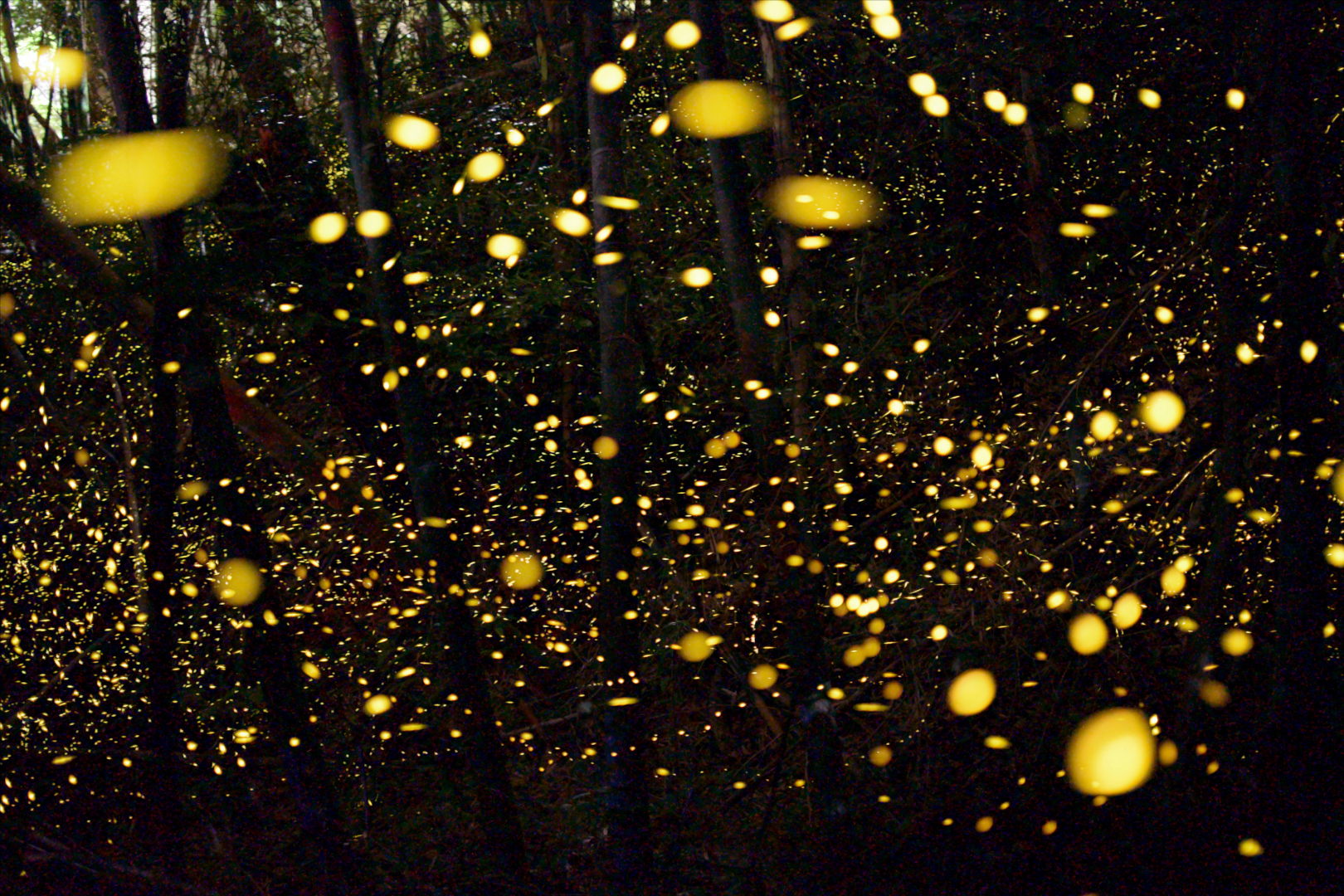
Surveys conducted since last year as part of this project have confirmed that the campus provides habitat for the Genji firefly (Luciola parvula), listed as Near Threatened in the “Osaka Prefecture Red List 2014.” In addition, Nakayama Pond hosts the striped goby (Rhinogobius sp.), also classified as Near Threatened in both the “Ministry of the Environment Red List 2015” and the “Osaka Prefecture Red List 2014.”
This project aims to conserve such valuable natural environments by securing financial resources through corporate CSR initiatives aligned with the SDGs and grants from various organizations. At the same time, it seeks to establish a platform where students, faculty, staff, local residents, and municipalities can collaboratively engage in biodiversity awareness, conservation, and education in an integrated manner. These efforts will also be linked to related research activities within the university.
Furthermore, environmental maintenance for conservation purposes is expected to contribute to disaster prevention and community safety in collaboration with local residents, as well as to the establishment of long-term ecosystems. Through these initiatives, the project aims to address societal challenges based on co-creation between the university and society, with outcomes that can also be utilized in environmental reports across various sectors.
In 2008 and 2009, the books Flowers Blooming on Campus (Osaka University Press), covering the Suita and Toyonaka campuses, were published, introducing campus vegetation. Although only surveys were conducted for the Minoh Campus, the results have been archived in a database at the University Museum.
The realization of a low-carbon society, a circular economy, and a nature-positive society are the three pillars of sustainability. As part of efforts to support a nature-positive society through biodiversity conservation, the Sustainable Campus Office has promoted awareness of nature conservation and biodiversity education within the university. Based on the “Osaka University Green Framework Plan (Revised 2018),” campus environments have been developed and maintained.
Going forward, the university intends to prioritize the protection of species requiring urgent conservation, create opportunities for dialogue among government, citizens, and the university, and strengthen institutional efforts in biodiversity conservation through funding acquisition, education, social co-creation, and research.
In Toyonaka City, the conservation of large green spaces is a pressing issue. The city’s Green Master Plan explicitly refers to Osaka University (Machikaneyama) and designates it as a conservation consideration area, highlighting the need for its protection. This issue extends beyond Machikaneyama alone; surrounding green spaces also require integrated conservation efforts that actively involve students and faculty while making effective use of these spaces.
The “Take no Kai” activities, which the Sustainable Campus Office has conducted in collaboration with the Shibaharacho community group, have shown success and are expected to yield similar results on the Suita Campus, where bamboo overgrowth is also a concern.
The project has two major short-term goals:
To collaboratively engage students, faculty, staff, local residents, and organizations in research and educational activities to better understand biodiversity on campus and in the surrounding region.
To create a flexible network and collaborative framework that enhances regional sustainability by encouraging participation in enjoyable biodiversity conservation activities, thereby expanding the community of participants.
Nuturing children and future with local community:
Practice and theory of the co-creation network
UWASU Michinori |Professor, Graduate School of Economics
To realize a society where no one is left behind and where life shines, within local communities, it is essential to build a co-creation network where various local stakeholders work together on envisioning and solving issues. This project aims to advance practical efforts of co-creation networks centered around community, children, and the future, and from these experiences and insights, to develop a theory of co-creation networks.
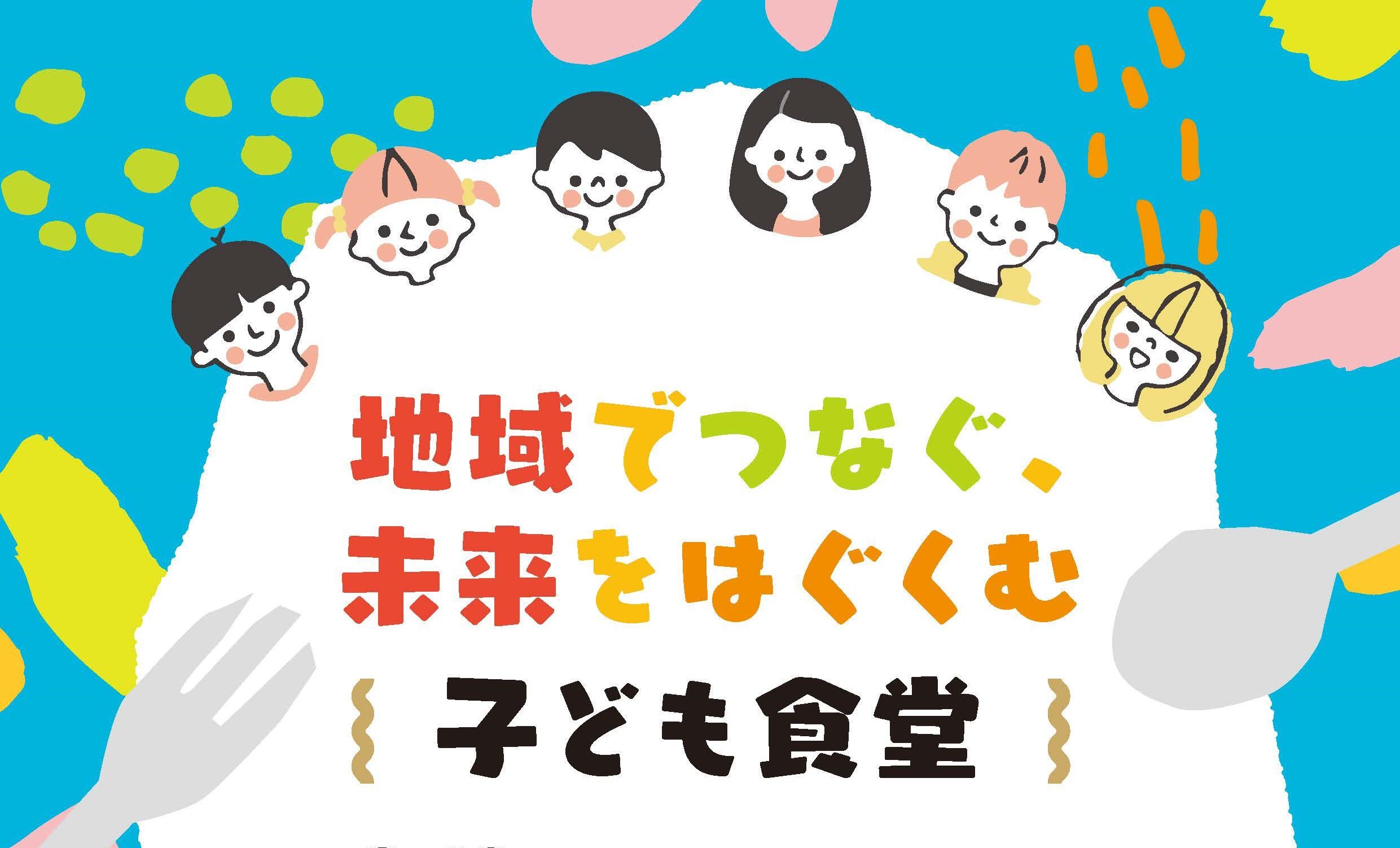
In this project's activities, the practice of the "Osaka Prefecture Children's Cafeteria and Local Government Liaison Council," involving administrative officials of Osaka Prefecture, intermediaries such as operators of children's cafeterias (places for children), and corporations, serves as a pillar. Children's cafeterias have rapidly increased nationwide during the COVID-19 pandemic. It has been reported from various quarters that not only beneficiaries but also supporters find mutual empathy through interaction in children's cafeterias, and many local governments and related parties are seen to support the establishment and operation of children's cafeterias. Children's cafeterias and places for children can be spaces where anyone in the community can participate and shine, and they can serve as core infrastructure for the realization of a society that cherishes life and where each individual shines. To achieve this, constructing a network where local stakeholders can collaborate, cooperate, and co-create is key.
Thus far, in collaboration with intermediate support organizations for children such as "Musubie," this project has hosted liaison meetings involving local government departments, social welfare councils, intermediate support organizations, and children's cafeteria operators in Osaka Prefecture to create spaces for dialogue and form networks. In these spaces for dialogue, core organizations will be identified to enrich and expand the network, aiming for the theorization of "co-creation networks."
Specifically, while exploring the function, role, and sustainability of the liaison council as a "co-creation network," we will proceed with actual research to form regional visions and identify and seek solutions to challenges.
The structure of the co-creation network envisioned by this project consists of the Osaka Prefecture Children's Cafeteria Local Government Liaison Council and universities, as shown in the diagram above. Here, information and voices from the field of policy and support are shared, dialogues about the community vision are conducted, and framing of issues and exploration of potential solutions are undertaken. Moreover, the information and insights accumulated here will be shared with stakeholders in various regions of the prefecture. At universities, not only does the liaison council play a role, but administrative offices also coordinate the participation of researchers and students, serving research and investigation functions. Through mutual cooperation, the aim is to facilitate the sharing of information, planning of research for vision realization and problem-solving, and the promotion of manpower, information, and resource exchange.
Furthermore, this project will build a theory of co-creation networks, referencing discourses and practices in transdisciplinary research, action research, and future design, based on the structure and outcomes of the stakeholders' co-creation network with keywords such as community and children. Additionally, academic outcomes and practical efforts will be actively communicated to society, advancing research that leads to policy suggestions and the discovery of new research themes.
Already, in the liaison council and academic meetings at universities, research topics have been identified, such as 1) the impact of involvement in children's cafeterias on wellbeing, 2) methods to visualize children's voices, and 3) ways to achieve community inclusion (e.g., participation of elderly males) through children's places. Through addressing these research and practical issues, this project aims to form a model co-creation network for communities nationwide.
Science and Humanity for Fostering a Super-aged Society that Respects Individual’s Views on Life and Death and Their Autonomy
YAMAKAWA Miyae | Associate Professor, Graduate School of Medicine
For these five and a half years, we have cultivated networks with neighboring local authorities, regional medical care, public health/welfare participants, and residents through the Osaka University’s cross-disciplinary research on dementia and the SSI’s core project “Creation of Super-Aging Society Encouraging Respect for Individual Views on the End-of-Life Good and Honorable Death and Supporting Personal Autonomy in Health Care.” In this project, we will further develop the activities and regional network to empower every person’s living in a super-aged society with diverse views on life and death.
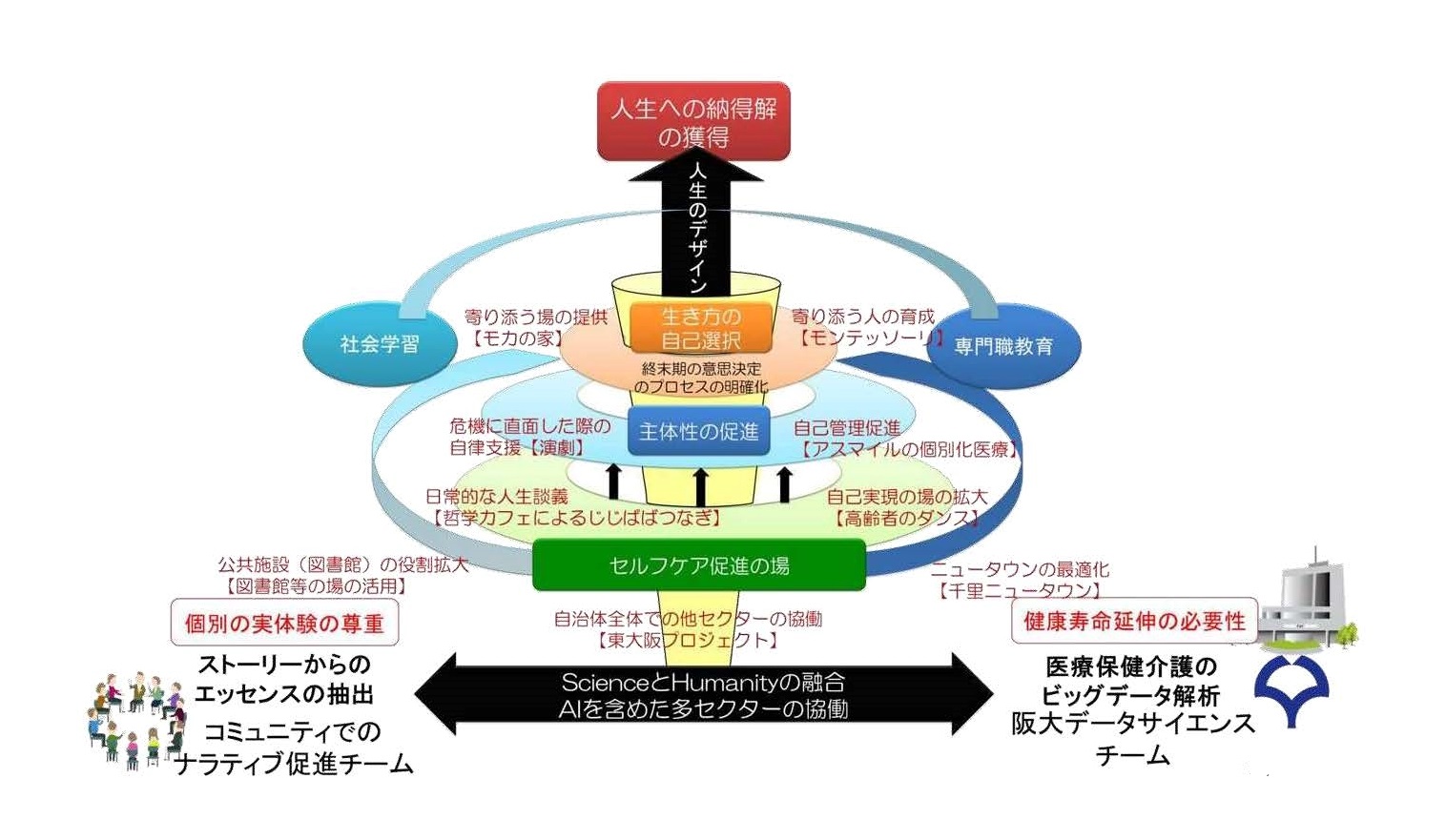
In this project, with a special emphasis on every person’s living in a super-aged society, we will design schemes that enable every person to create their own lives through learning and feeling close to social networks. Through developing an approach that combines each person’s “humanity” and “science”, the project aims to organize an environment where individuals can design their own life as an “art” and obtain a solution to various problems caused by aging that is satisfactory to themselves.
“Autonomy,” as defined in this project, does not mean that one must do everything on one’s own, but rather that one can express one’s will to the end of one’s life as much as possible with using various resources in the community. This project will aim to foster a super-aged society that respects individual’s views on life and death and their autonomy.
Specific activities of this project include,
1.To visualize peaceful end-of-life care practices that enhance the dignity of the individual to the end of life in serviced housing for the elderly and to examine its educational methods
2.To establish outpatient nursing care for Mild Cognitive Impairment with using ICT
3.To assess spaces for community’s coexistence in public libraries
4.To create a methodology to activate local community in aged new towns
5.To extract ways to reduce medical and healthcare costs and promote autonomous health behaviors with using big data linking medical care receipts and specific health checkup data in Osaka Prefecture
6.To increase opportunities where the elderly can express themselves
7.To establish local medical and healthcare network
8.To hold philosophy café and forum by other sectors in neighboring municipalities (e.g. library)
9.To facilitate “bana game” and application that can foster individual’s views on life and death, thereby to visualize factors that affect human psychology
10.To organize data for above-mentioned data science and to actively promote collaboration with companies if necessary
Realization of an empathetic economy through the promotion of stakeholder-ESG management, ethical consumption and sustainable procurement
ITO Takeshi |Professor, SSI
Currently, many companies have already started to ensure and manage that the materials they procure are made appropriately and the working environments at their suppliers are adequate. The term "CSR (Corporate Social Responsibility) procurement" has become commonly heard.
Thirty years have passed since the concept of "Sustainable Development" was proposed in 1987, and during this time, a considerable amount of effort and time has been invested. In 1994, the concept of the "Triple Bottom Line," encompassing environment, society, and economy, was advocated, promoting voluntary CSR actions by companies. Furthermore, investors have increasingly prioritized ESG (Environmental, Social, and Governance), leading many companies to disclose ESG information through integrated reports, demonstrating their actions and outcomes to stakeholders and engaging in dialogue.
Regarding consumers, there has been a long history of movements towards "ethical consumption," which aims to purchase good products and services from good companies that benefit society. From decades ago, there have been consumer movements for ensuring health and safety, preventing pollution, and reducing environmental impact, the publication of "Consumer Reports" which provides independent comparisons of a wide range of products and services, and the establishment of certifications like "Fair Trade" that ensure continuous purchase of raw materials and products from developing countries at fair prices, and "Rainforest Alliance" certification, indicating products are produced using methods that strengthen the three pillars of sustainability (social, economic, environmental).
Now, with the evolution of mobile devices and social media, consumers have the potential to obtain information about the products and services offered by companies, sometimes even equivalent to the companies themselves, to understand whether businesses are conducting honest operations and employing workers in good working environments, enabling informed purchasing and usage decisions.
If every consumer can discern and purchase/use good products from good companies, it will enrich the people working honestly in those companies and, in turn, enrich themselves.
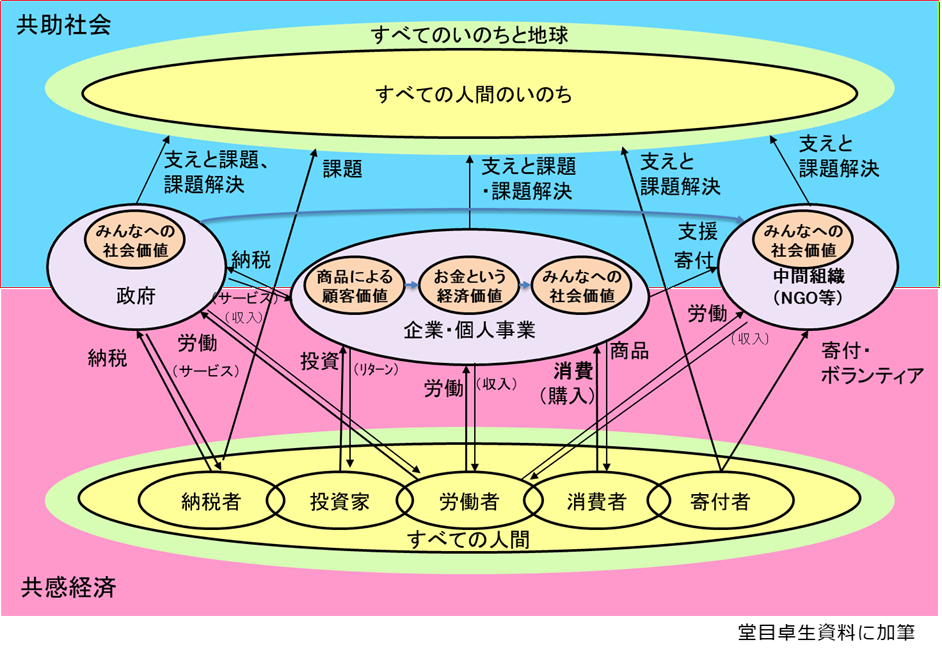
As Adam Smith observed, many people are equipped with the capacity for empathy, putting themselves in others' positions. The time has come when, based on mutual empathy, companies create products from the perspective of consumers, and consumers purchase and use products with knowledge of the companies' actions, creating a market economy and society that are rich both economically and humanly. The main actors in realizing this society are companies and consumers who care about society.
Against this background, we will undertake initiatives to realize an "Empathy Economy through the Promotion of Stakeholder-ESG Management and Ethical Consumption & Sustainable Procurement." The objective, as the title suggests, is to promote "Stakeholder-ESG Management" on the corporate side and "Ethical Consumption & Sustainable Procurement" as the core. This requires behavioral changes on both the corporate side and the procurement/consumption side, and we will proceed to promote these.
On the corporate side, we will spread good practices of stakeholder management, purpose-driven management, and ESG management orientation, such as those of the Kurumaza no Kai (Roundtable) members, across industries and companies. Specifically, we will share stakeholder-oriented issues that emerged from the Kurumaza no Kai, aim to solve problems related to ethical and sustainable consumption and procurement, energy, environment, labor, etc., and consider spreading stakeholder, purpose, and ESG management orientation to many non-listed companies, including SMEs, not just listed companies.
On the consumption and procurement side, we will advance initiatives to encourage ethical and sustainable actions by garnering empathy for the companies' efforts. Specifically, this includes developing ethical and sustainable procurement and consumption tools, developing tools for online collection of company information, and planning for the selection and promotion of usage industries, fields, and regions.